
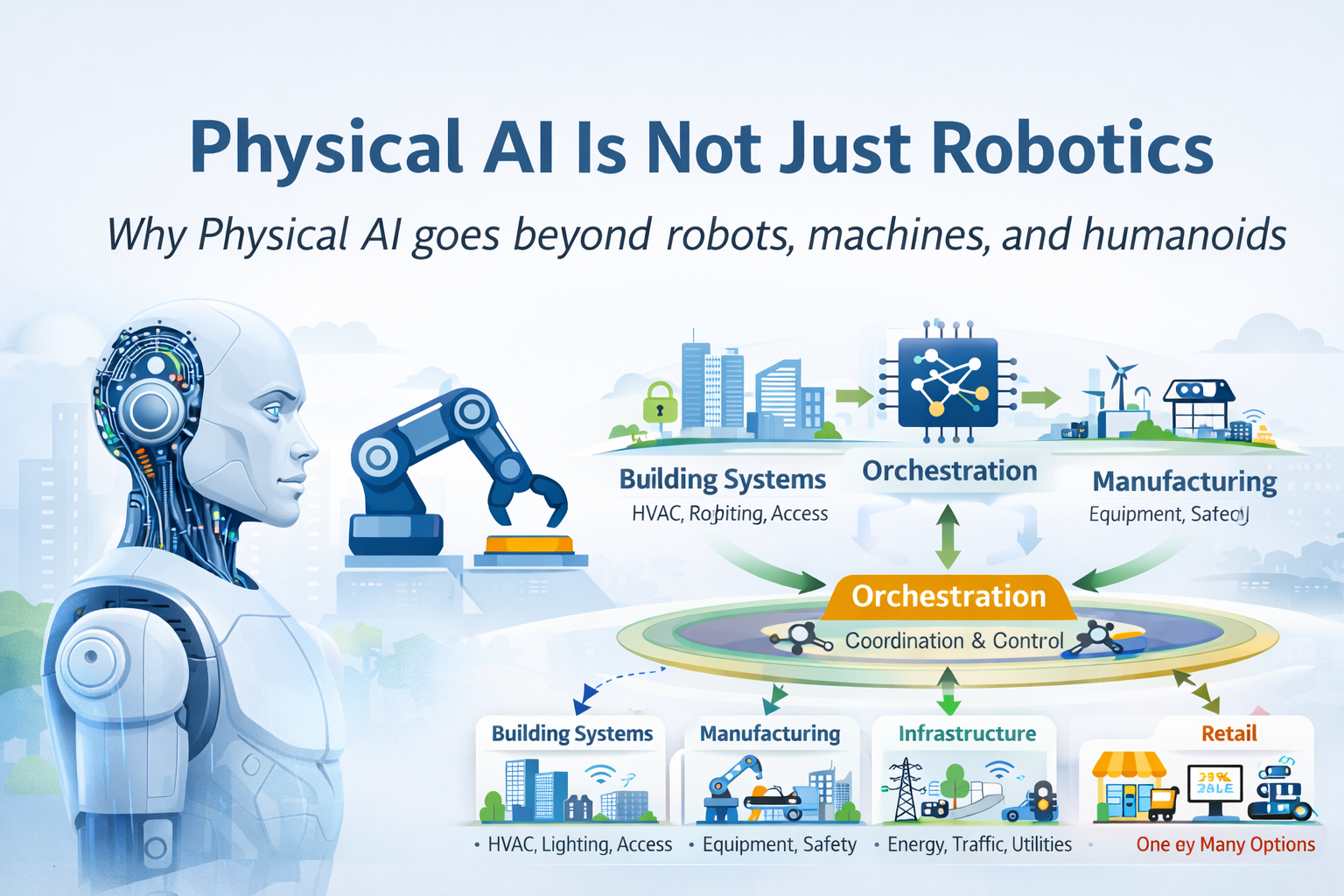
Why Physical AI goes beyond robots, machines, and humanoids
When the term Physical AI is mentioned, robotics is often the first association. Images of humanoid robots, autonomous machines, and robotic arms dominate public discussion and media coverage. While these systems are highly visible and technologically impressive, they represent only one part of a much broader Physical AI landscape.
In real-world deployments, Physical AI is less about robots themselves and more about how intelligent systems interact with physical environments. Robotics is one way these systems can act, but it is neither a requirement nor the most common starting point.
This article explains why Physical AI should not be equated with robotics, highlights non-robotic Physical AI systems already in use, and clarifies how orchestration and logic-based processing connect everything together.
The association between Physical AI and robotics is understandable. Robots provide a tangible and intuitive representation of intelligence acting in the physical world. Their movement, autonomy, and physical presence make them easy to demonstrate and communicate.
Historically, robotics was one of the earliest domains where AI techniques were applied to physical systems. More recently, increased visibility around humanoid robots has reinforced the perception that Physical AI and robotics are synonymous.
However, this focus on form factor obscures a more important question: what actually makes an AI system physical?
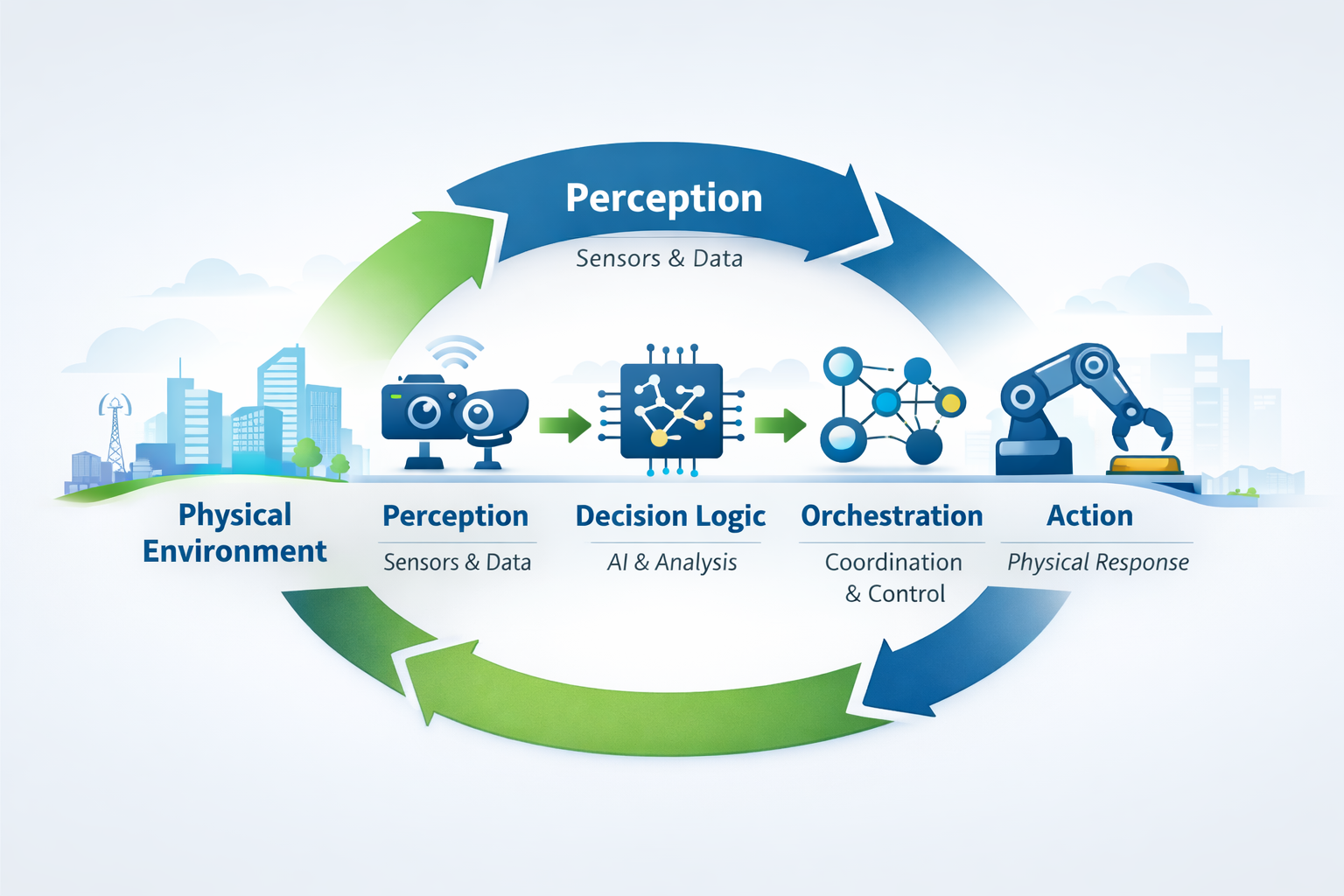
An AI system becomes physical not because it has a body, but because it participates in a closed-loop interaction with the real world.
Physical AI systems:
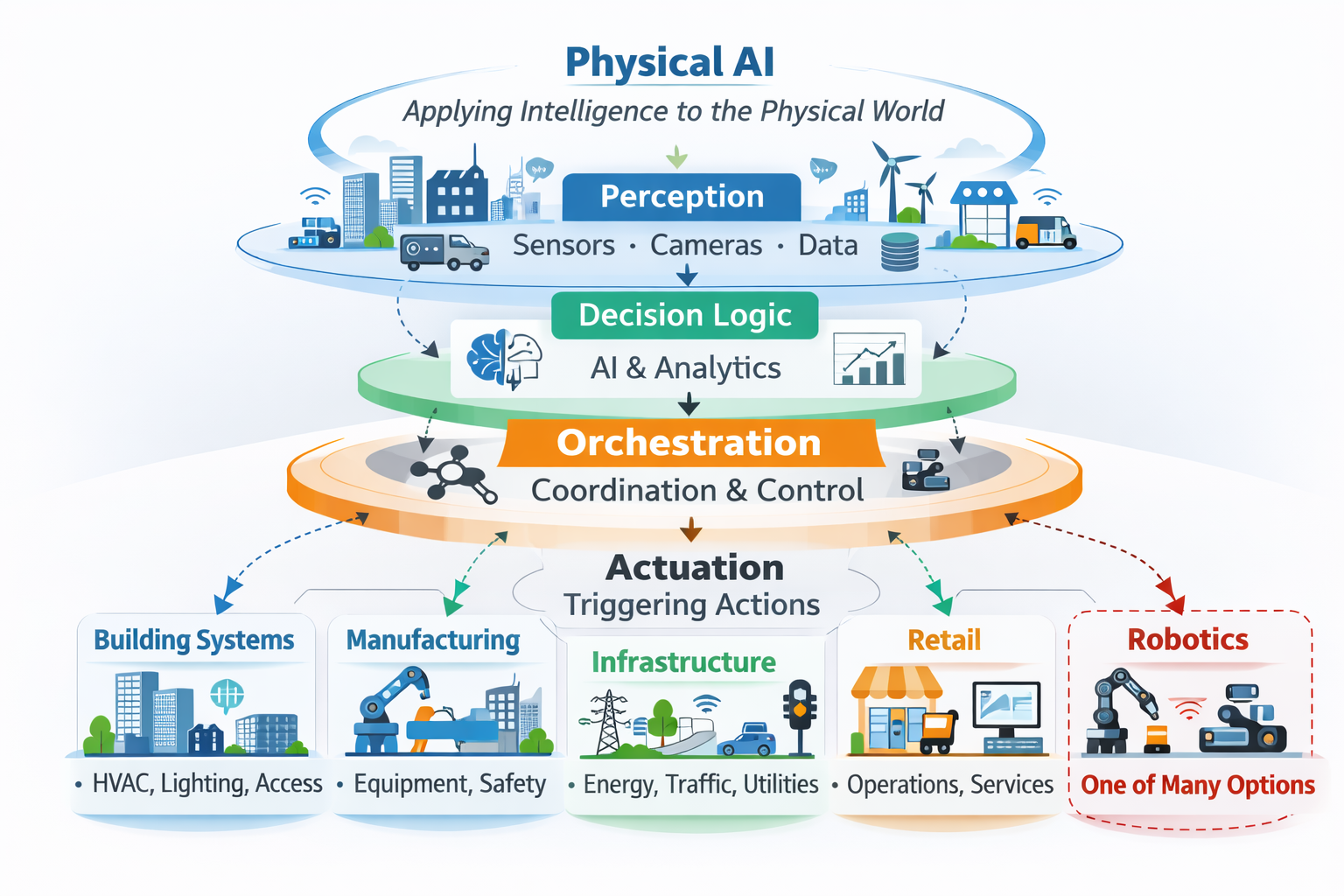
This sense–decide–act loop is the defining characteristic of Physical AI. Whether the action is carried out by a robot, a building system, industrial equipment, or an automated workflow is secondary.
From this perspective, robotics is simply one form of actuation within a Physical AI system.
Many Physical AI systems already operate at scale without robotics.
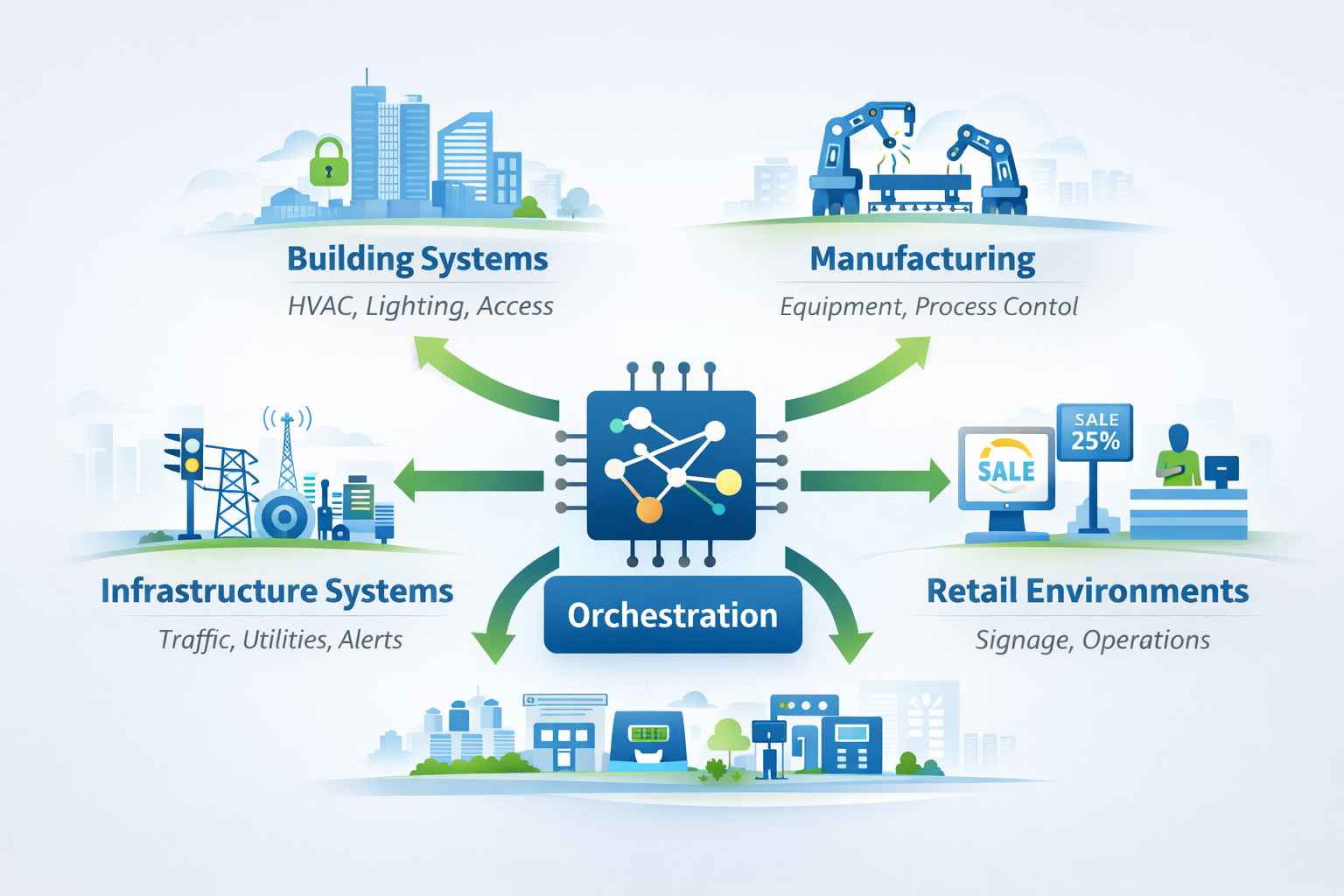
Smart buildings use sensors and computer vision to adjust HVAC, lighting, access control, and energy usage based on occupancy and environmental conditions. Manufacturing environments apply vision and sensor feedback to detect defects, improve safety, and optimize processes without autonomous machines. Infrastructure systems manage traffic flow, energy distribution, or safety alerts using real-time signals and automated responses. Retail environments dynamically adjust signage, staffing, or operations based on footfall and behavior.
These systems meet all the criteria of Physical AI. They sense physical conditions, apply logic or inference, and trigger actions that directly affect the real world. The absence of robots does not make them any less physical or intelligent.
There are practical reasons why Physical AI initiatives often begin without robotics.
Non-robotic systems typically involve lower cost and complexity, fewer safety and regulatory constraints, and faster deployment timelines. They allow teams to validate perception, logic, and orchestration using existing infrastructure before introducing hardware that is expensive and difficult to modify.
Starting without robots also shifts focus from machine behavior to system behavior, enabling iterative improvement and clearer evaluation of where intelligence delivers value. In many cases, orchestration and logic-based processing deliver measurable outcomes on their own.
The Role of Orchestration in Physical AI Systems
Across both robotic and non-robotic deployments, orchestration plays a central role.
Orchestration connects perception to action. It determines how signals from sensors, cameras, and systems are interpreted, how decisions are made, and how actions are coordinated across environments. It also provides the flexibility required to adapt behavior, integrate new systems, and manage complexity over time.
Without orchestration, Physical AI systems tend to become brittle and difficult to scale. With it, they remain adaptable and production-ready.
Within this broader context, robotics fits naturally as one form of actuation.
Robots become significantly more effective when integrated into a wider Physical AI system. They benefit from shared perception, coordinated decision logic, and orchestration that aligns robotic behavior with buildings, equipment, and operational workflows.
Seen this way, robotics is often a later stage in a Physical AI journey rather than the starting point.
Implications for How Organizations Should Approach Physical AI
Understanding that Physical AI is not synonymous with robotics changes how organizations should approach deployment.
It encourages teams to focus on system design rather than hardware acquisition, to prioritize orchestration and logic before automation, and to treat Physical AI as an evolving capability rather than a one-time project.
This approach enables practical deployments today while creating a foundation for more advanced automation in the future.
Closing Perspective
Physical AI encompasses far more than robots. It represents a system-level approach to applying intelligence to the physical world, whether actions are carried out by robots, building systems, industrial equipment, or automated workflows. By treating robotics as one component within a broader Physical AI framework, organizations can focus on building scalable, adaptable systems that deliver real-world value.
In practice, achieving this requires more than models or devices. It requires an orchestration and logic layer that can connect sensors, interpret conditions, coordinate decisions, and trigger actions reliably across edge and hybrid environments. Gravio is designed specifically to fulfil this role, providing the logic-based processing and orchestration capabilities needed to turn Physical AI concepts into deployable, production-ready systems. If you are exploring how to move beyond experimentation and build Physical AI as an operational capability, reach out or contact us to kick-start your Physical AI journey with Gravio.


