
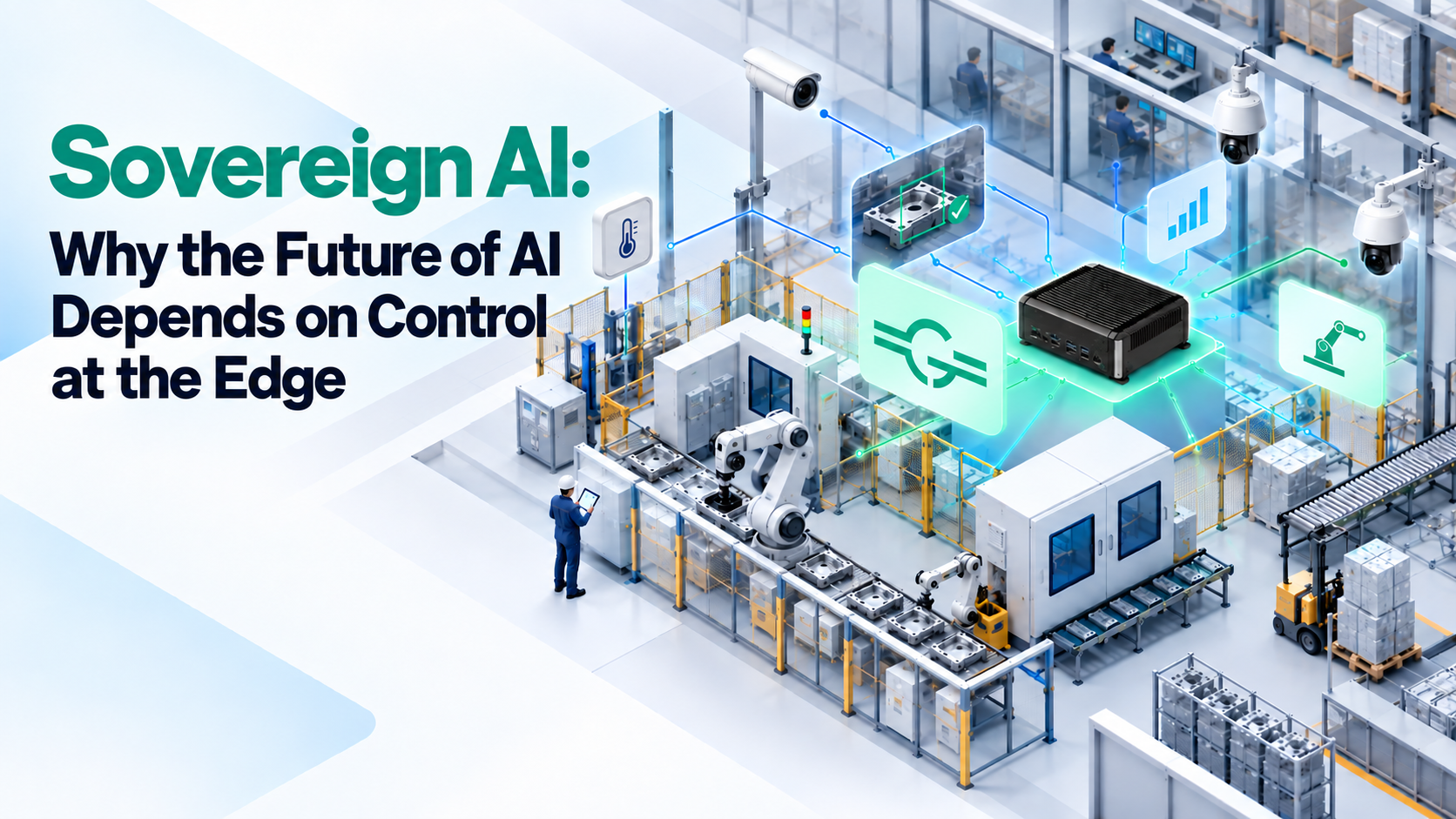
As artificial intelligence moves from digital applications into physical operations, organizations must consider not only what AI can do, but how much control they retain over the systems that power it. That question sits at the heart of sovereign AI.
Artificial intelligence is becoming an integral part of enterprise operations. Across manufacturing facilities, smart buildings, and critical infrastructure, AI is increasingly being used to monitor equipment, interpret camera feeds, detect abnormalities, and support automated responses.
This evolution represents a significant change in how businesses depend on AI.
Unlike traditional AI applications focused primarily on generating information or analyzing historical data, these systems interact with operational environments where events unfold continuously. An equipment fault, safety incident, or environmental abnormality may require a timely response, regardless of whether external connectivity is available.
As AI takes on a more active role in these environments, organizations face a new challenge: maintaining control over the intelligence that increasingly supports their operations.
This is where sovereign AI becomes relevant.
While sovereign AI is frequently discussed in the context of national technology strategies and data residency, its implications extend directly into enterprise architecture, operational resilience, and long-term technology independence.
For organizations deploying AI in the physical world, sovereignty is becoming an operational consideration rather than simply a matter of where data is stored.
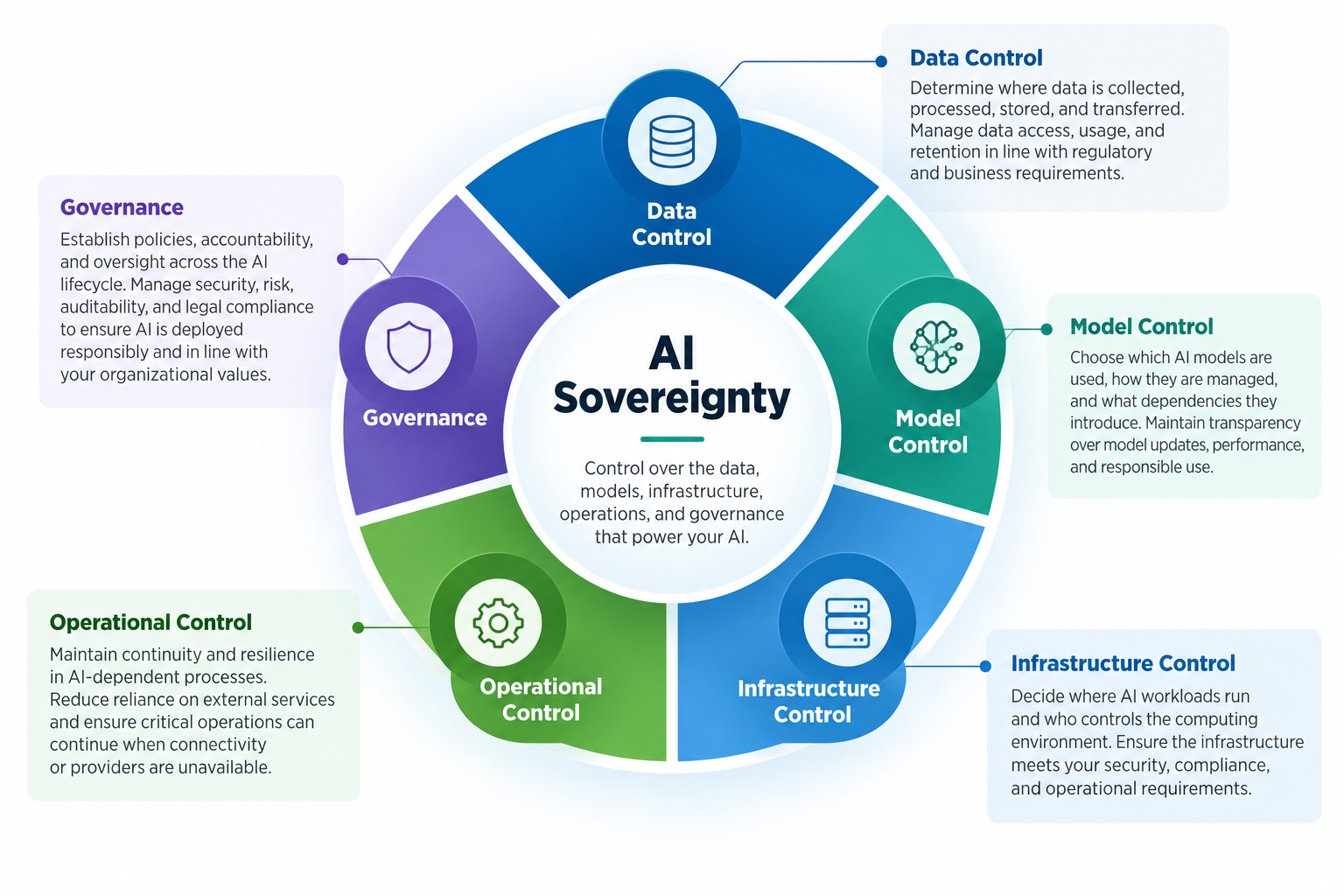
Sovereign AI refers to the ability of an organization or nation to maintain meaningful control over its AI capabilities, including data, models, infrastructure, and the processes governing their use.
Data residency, a core element of data sovereignty, remains an important part of this discussion, particularly for organizations operating under specific regulatory or contractual requirements. However, storing information within a particular geographic boundary does not necessarily mean the entire AI system operates under the same degree of control.
An organization may retain its operational data on local servers while relying on externally hosted AI models to interpret camera footage, process sensor information, or generate decisions.
In such an arrangement, the organization controls where its data is stored but may still depend on third-party infrastructure for essential AI capabilities.
This distinction is reflected in IBM's discussion of AI sovereignty, which considers control across the broader AI ecosystem rather than treating sovereignty solely as a question of geography.
Together, these dimensions provide a more complete way to evaluate how much control an organization retains over its AI systems.
The importance of AI sovereignty becomes clearer when artificial intelligence is embedded into everyday operational processes.
Consider a manufacturing facility using AI-powered cameras to monitor production equipment.
The cameras continuously capture information from the production line, while an AI model analyzes the footage to identify unusual conditions, potential defects, or safety-related events.
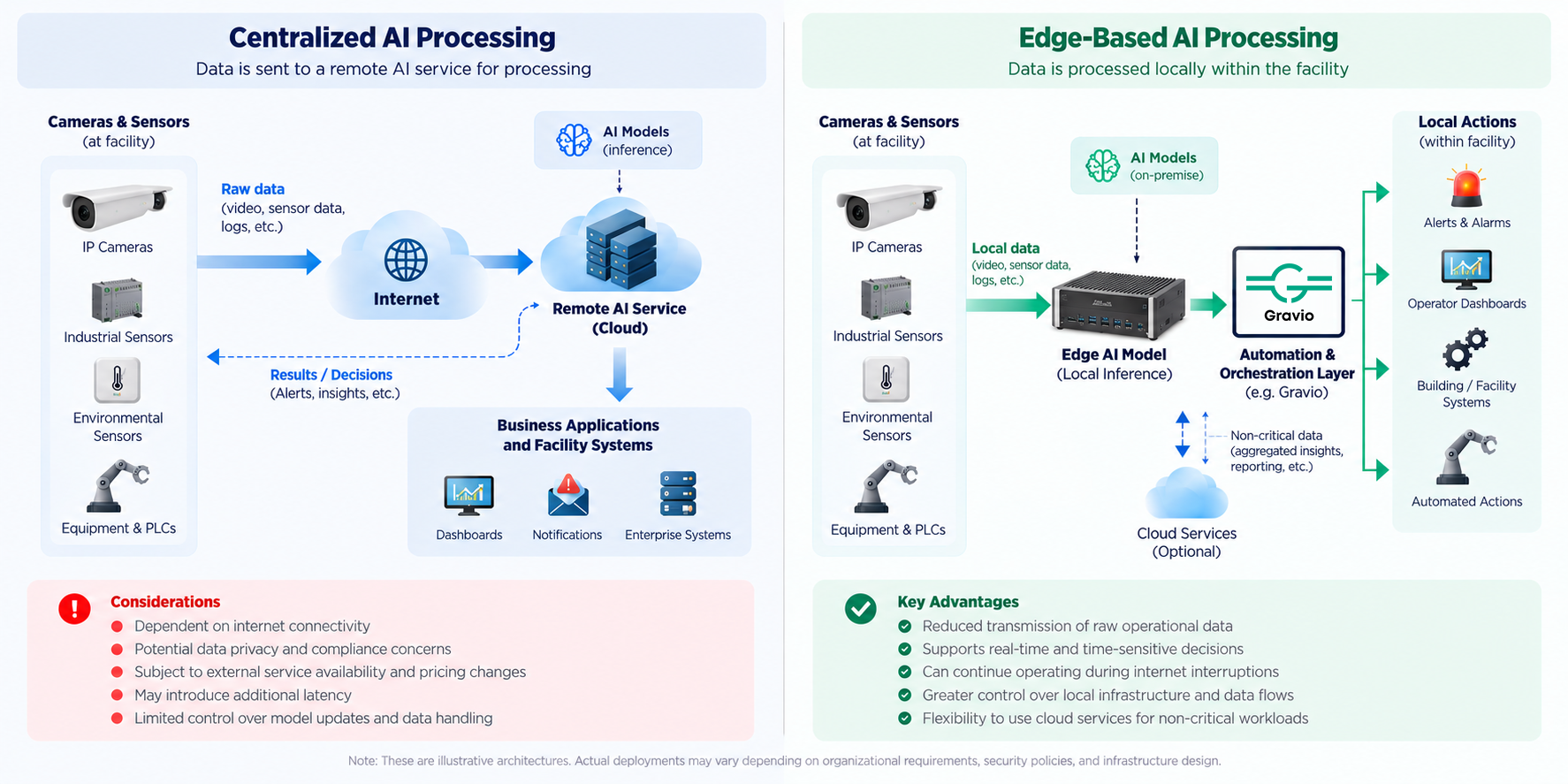
In a centralized architecture, the footage may be transmitted to an external AI service for inference. The resulting detections are then returned to the facility, where they are used to notify operators or initiate downstream workflows.
This arrangement may work effectively under normal conditions. However, the availability of the monitoring function can become dependent on external connectivity and the AI provider's infrastructure.
A network interruption or service outage could delay or suspend detection, even though the cameras and production equipment remain fully operational.
The same concern extends beyond manufacturing. Building monitoring systems, environmental sensing applications, and other AI-enabled operational workflows may face similar dependencies.
For CIOs and CTOs, these dependencies introduce business continuity and technology governance considerations. For operations managers, they can affect the reliability of systems used to support daily activities.
The issue is not that external AI services are inherently unreliable. Cloud-based AI provides substantial benefits, including access to advanced models and scalable computing resources.
Rather, the concern is whether critical operational functions have been designed around dependencies that the organization cannot adequately control.
The NIST AI Risk Management Framework provides a useful foundation for thinking about these challenges, emphasizing the need to govern, map, measure, and manage AI-related risks throughout the system lifecycle.
For organizations moving AI into production environments, dependency management should become part of that broader risk assessment.
Edge AI offers a practical way to reduce selected dependencies by allowing AI workloads to operate closer to where information originates.
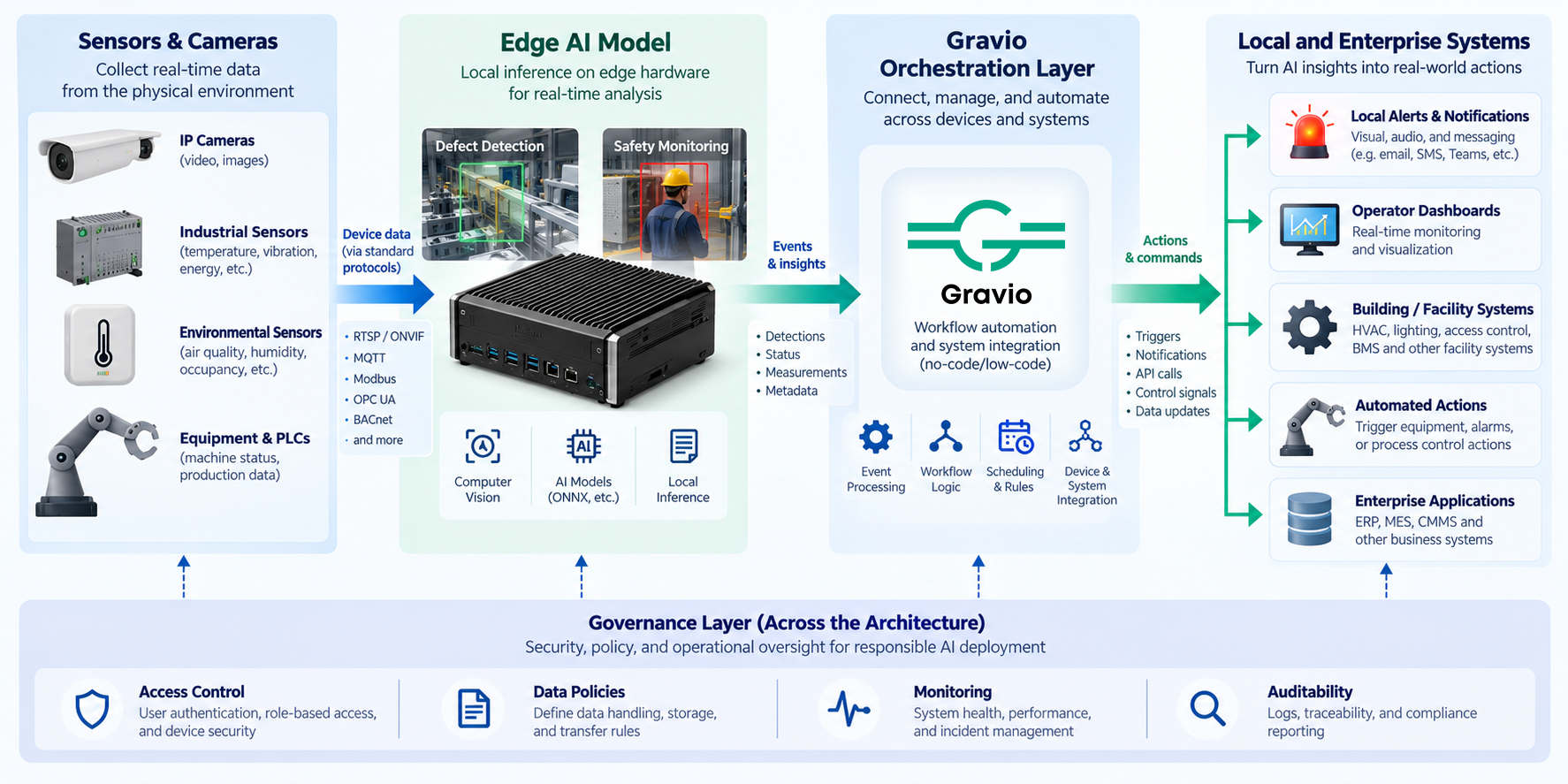
Instead of transmitting every camera frame or sensor reading to a remote service, organizations can deploy suitable AI models on local computing infrastructure, including industrial PCs, edge servers, or other capable devices.
Returning to the manufacturing example, a locally deployed computer vision model could analyze production-line footage within the facility itself. Running models on-site in this way is known as local AI inference.
When the model detects an abnormal condition, the resulting event can be passed to a locally operating automation system. Depending on the workflow, this might generate an operator notification, record an incident, or trigger an authorized response.
If the necessary inference, orchestration, and communication components are available locally, the workflow can continue functioning during an interruption to external internet connectivity.
This changes the organization's operational dependency.
Rather than requiring remote processing for every detection, selected decisions can be made and acted upon within the facility's controlled environment.
Edge AI can also reduce the need to transmit raw operational data externally, support lower-latency responses, and provide greater flexibility over how information moves between systems.
These advantages are particularly relevant where AI interacts with physical infrastructure and where delays or service interruptions have operational consequences.
The architectural considerations behind this approach are explored in Gravio's article, Should Physical AI Run at the Edge, in the Cloud, or Both?.
Deploying an AI model locally addresses only part of the challenge.
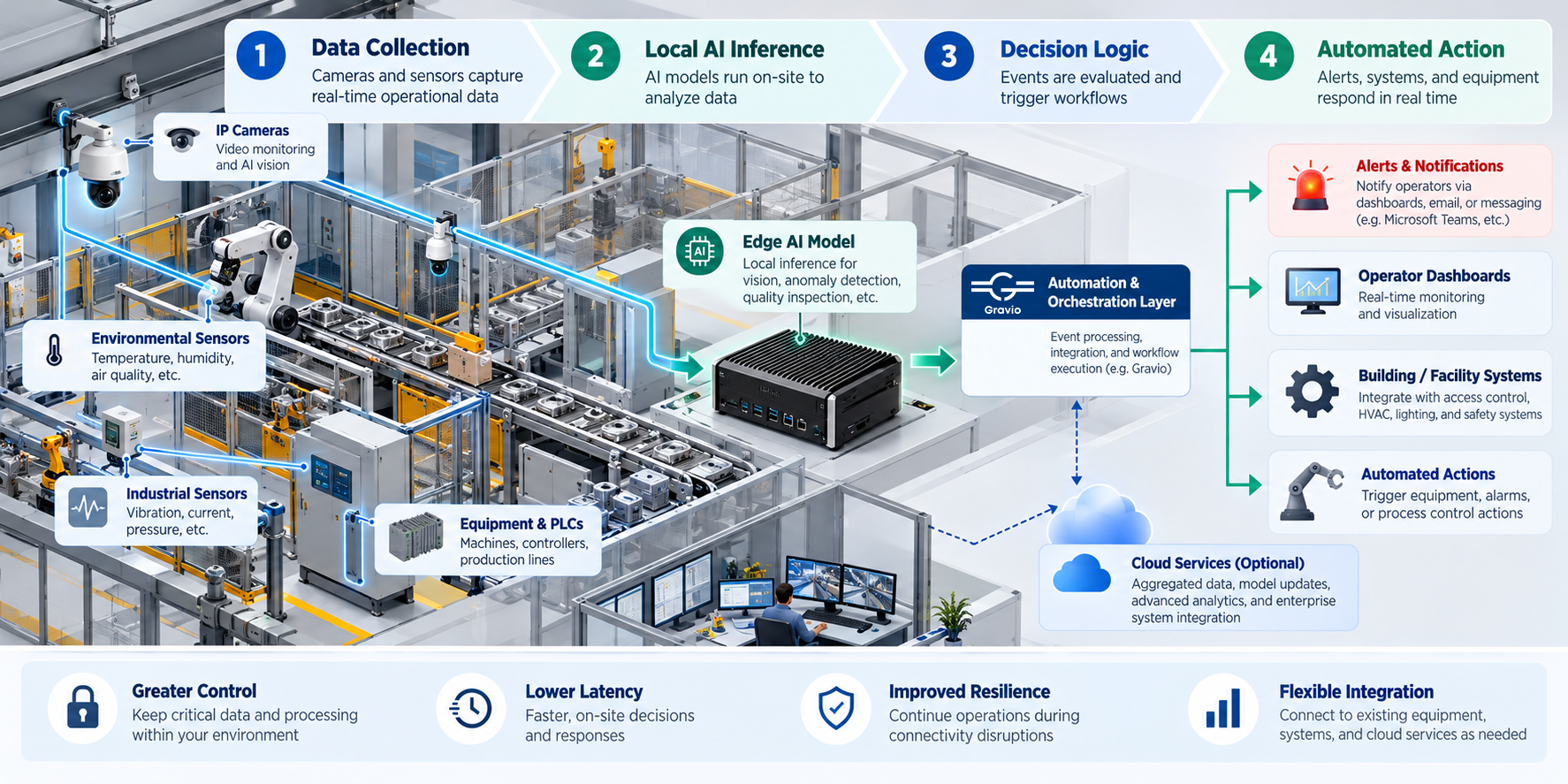
For AI to support real-world operations, its outputs must be connected to existing equipment, applications, and business processes.
In a manufacturing environment, cameras, industrial controllers, environmental sensors, and enterprise applications may operate through different interfaces and communication protocols.
An AI model might identify a defect or abnormal equipment condition, but the organization still needs a mechanism to interpret that event and coordinate an appropriate response.
This is where integration and orchestration become important.
A detection may need to generate an alert, update a dashboard, notify a technician, or initiate a predefined workflow. The surrounding systems must also handle operational rules, permissions, and exceptions.
Sovereign AI in physical environments therefore involves more than controlling where inference runs. It also requires control over how AI-generated insights are translated into operational decisions and actions.
Platforms such as Gravio help address this integration layer.
Gravio is a no-code/low-code edge computing platform designed to connect sensors, cameras, devices, and software systems through configurable automation workflows.
By supporting locally deployed integration and orchestration, Gravio can help organizations coordinate selected AI-enabled workflows within their own environments, subject to the deployment architecture and external services involved.
This can reduce the need to develop custom integrations for every device and application while allowing organizations to retain greater flexibility over how their operational systems interact.
Gravio's Axis Partner Solution Note on Edge AI and Physical Automation provides an example of how AI-enabled devices and automation workflows can be brought together.
The distinction is important: Gravio does not, by itself, establish complete AI sovereignty. Its contribution is to provide an integration and orchestration layer that can support locally controlled workflows as part of a broader architecture.
As organizations evaluate AI adoption, attention naturally gravitates toward model performance, implementation costs, and the capabilities a solution can deliver.
These remain important considerations. However, systems intended for operational use should also be assessed according to the control and resilience they provide.
A practical starting point is to identify which AI-enabled functions are essential to ongoing operations.
For each critical workflow, organizations can examine where data is processed, which services it depends on, what happens during connectivity interruptions, and how easily components can be replaced or maintained.
This approach helps distinguish between workloads that benefit from local execution and those for which externally hosted services remain appropriate.
It also encourages organizations to consider interoperability and lifecycle management from the beginning, rather than treating them as problems to resolve after deployment.
For example, a manufacturing facility may determine that certain safety-related monitoring or equipment alerts should remain available locally, while non-critical reporting and longer-term analysis can tolerate external dependencies.
The resulting architecture is guided by operational requirements rather than a blanket preference for any particular computing environment.
Over time, this approach can help organizations build AI systems that are easier to govern, maintain, and adapt as technologies evolve.
Sovereign AI is the ability of an organization or nation to maintain meaningful control over its AI capabilities, including the data, models, infrastructure, and processes that govern how AI is used.
No. Data residency concerns where data is stored. Sovereign AI is broader: it also covers which models are used, where inference runs, who operates the infrastructure, and whether critical AI-dependent workflows remain available when external services are not.
Edge AI runs models on local infrastructure, close to where data is generated. Local AI inference reduces dependence on external connectivity and third-party services, limits how much raw data leaves the site, and helps keep critical operational workflows under the organization’s control.
No. Most organizations will use a mix of edge and cloud AI. The aim is to decide deliberately which workloads need local control for resilience or compliance, and which can rely on externally hosted services.
As artificial intelligence moves deeper into physical operations, the meaning of sovereignty will extend beyond data residency and infrastructure ownership.
Organizations will increasingly need to understand how AI systems depend on external services, how those dependencies affect operational continuity, and which parts of their technology environment require greater local control.
Edge AI provides an important architectural option by allowing selected intelligence and automation capabilities to operate closer to the environments they serve.
When supported by appropriate integration, security, and governance practices, this can help organizations reduce unnecessary dependencies while retaining control over critical workflows.
Ultimately, the goal is not to eliminate every external dependency or to own every component of an AI system.
It is to make deliberate decisions about which dependencies are acceptable and which operational capabilities must remain under the organization's control.
As AI becomes part of the infrastructure businesses rely on, the ability to maintain that control will become as important as the intelligence itself.
Take the Next Step Toward Greater AI Control
Building sovereign AI starts with understanding where your operational dependencies lie and how greater local control can improve resilience. With Gravio, organizations can connect AI, sensors, cameras, and operational systems through flexible, no-code/low-code edge automation.
Explore Gravio to discover how you can bring intelligence and automation closer to your operations while maintaining greater control over your infrastructure and workflows.


